|
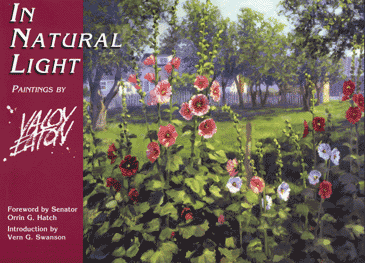
Forword By Senator Orrin G. Hatch
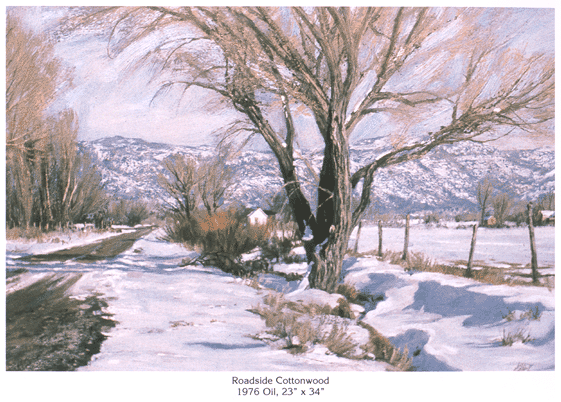
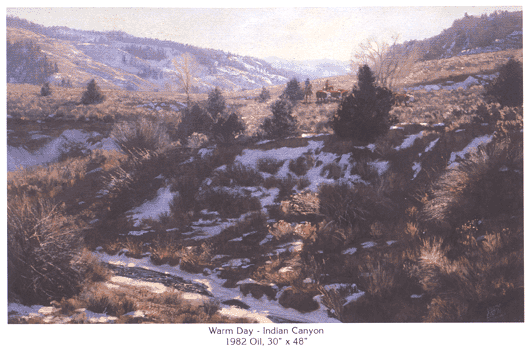
Valoy Eaton's incredible body of work - the deep brush
lines, the marvelous use of light, the bright colors and hues, the
impressive landscape vistas, and every so often the inspired use
of children and women, neighbors, friends, and loved ones - all
evoke a special beauty that celebrates America at its best.
I call the Eaton paintings "realistic
impressionism." There is an impressionistic quality to
Valoy's work that evokes an image few will ever forget. His rich
palette and his genius use of hallmark themes-landscapes,
hollyhocks, streams, luscious sage brush, horses, farm animals,
birds, rivers, and mountains-all are so magnificent they render
words insufficient to describe their luminous beauty.
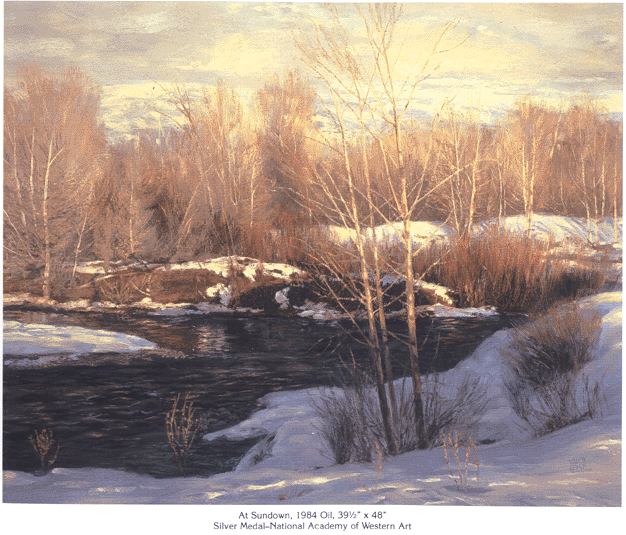
And of course, Valoy is a master of light. His magical
depiction of light dancing across mountains, trees, shrubs,
rivers, streams, snow vistas, and pioneer scenes is not easily
forgotten. To view Valoy's paintings gives one a perspective of
just how much he loves the west and the beauties of nature. He has
a genius for finding just the right kind of lighting and scenery.
Whether it is a landscape of the shallow pastoral Susquehanna
River in Northern Pennsylvania, a portrait of my wife, Elaine,
picking raspberries in the garden, or a painting of cattle on the
range being herded by cowboys, the observer experiences a feeling
of joy and peace at the same time. Valoy is a person who looks at
life and responds. He has a pure appreciation of people and light.
It is for these reasons that I probably own more Valoy
Eaton paintings than anyone alive, including Valoy and Ellie
Eaton, his wife. I started collecting them when Valoy was teaching
art and coaching basketball in high school. I have followed his
and Ellie's careers for many years and have reveled in the acclaim
he has achieved by other collectors, museums, art contests,
including the Cowboy Hall of Fame, by various collectors, and by
those who love fine art and recognize Valoy's special genius.
Valoy's pioneer paintings are already classics. They
show the vibrancy of the early builders of our nation,
particularly the west. As we gaze, with appreciation, one can
almost imagine the strength, courage, fortitude, faith, and
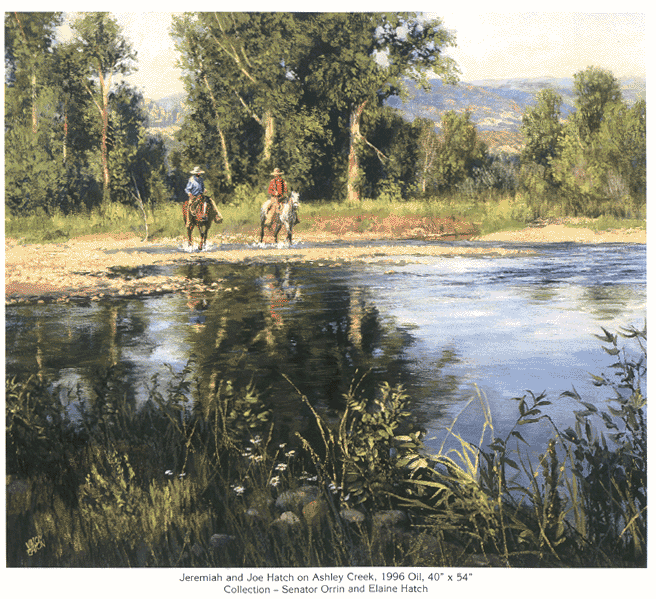
decency of the pioneers who settled the west. His huge painting of
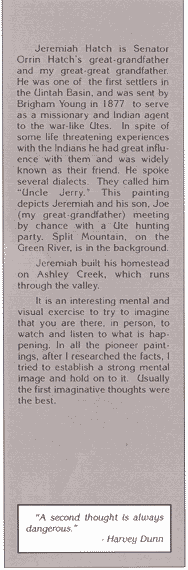
my great grandfather, Jeremiah Hatch, and his son Josephus, my
grandfather, crossing over Ashley Creek (pg. 97), hangs in my
Senate office in the Hart building directly over my desk. Leaders
from all over the world have mentioned how truly remarkable it is.
One of my favorite paintings is the one he painted for
me of five old overall-dressed ranchers standing there with the
backsides of their four horses showing (pg. 31). It is American
classic. I call it the "Five Republicans and four
Democrats." It is a small, but significant painting.
Virtually everyone who visits my Salt Lake City office loves it.
Valoy's paintings are in great demand. He still takes
commissions, but loves to do his own subjects and themes while
roaming over our country's beautiful and spectacular terrain. He
ranks among the finest artists of our time and, I believe, his
work will be accepted as magnificent for centuries to come.
Talents like Valoy's point us to the existence of God
and his work. And only God could have inspired and magnified his
earthly talent enabling him to create some of the most beautiful
landscapes ever created. This book is the first opportunity for
many to become familiar with his outstanding work, and also to
gaze on a special collection of some of his most beautiful and
refined work-the artwork (25 precious and august paintings) he
voluntarily painted and gave to the Church of Jesus Christ of
Latter-day Saints for its temples. Valoy is so respected, he was
able to obtain special permission to display, in this book, these
magnificent paintings, which are not available to the general
public, because of their use in the sacred temples.
So today, we are all fortunate to have this amazing
compilation of Valoy's work. The joy Valoy's work has brought to
my wife, Elaine, and me and countless others is inexpressible, and
I hope each of you will share in that bounty as you savor the many
riches he offers.
Orrin G. Hatch
U.S. Senator, State of Utah, 2002 |
|
Introduction Page XXVii - By Vern G. Swanson, Ph.D Director,
Springville Museum of Art back to top
|
charity auctions and fund-raisers. He has also volunteered
to be the coach of youth baseball and basketball teams
throughout the years.
A great
honor was bestowed in the early 1980s, when the Granite
School District began to make an annual art award called
"The VaLoy Eaton Scholarship." He had taught in
the Granite District for ten years and left a lasting
impression. Then, in the 1990s, Zions Bank in Vernal began
giving the Eaton Art Scholarship for Uintah High, where he
received the "Distinguished Alumnus Award." His
portrait now hangs in the school alongside other
honorees.35
An article
on VaLoy appeared in 1981 in Southwest Art magazine. Eaton
asked Vern Swanson to write it because, as he said
humorously, "You're the only person I know who
understands art, who likes my paintings!" This was not
exactly true, but it was flattering to Swanson, who went on
to write another six articles on different artists for
Southwest Art. The magazine article was followed by a large
retrospective exhibition at the Springville Museum of Art in
October 1982. The show, which was cosponsored by Senator
Orrin and Elaine Hatch, included seventy-three carefully
selected paintings.
Reviewing
the exhibition, George Dibble, art editor for the Salt Lake
Tribune, pronounced VaLoy Eaton to be the best landscapist
now working in the state. This watershed exhibition at the
artist's mid-career was a period of personal reassessment.
It strengthened his determination not to "potboil"
or paint "second, third or fourth variants" of his
best work.
He resolved
to keep pushing for original, strong, and sensitive visual
statements in each piece he painted. The vigor of Eaton's
work during the last score of years was based on the
decision in 1982 to please his own internal
|
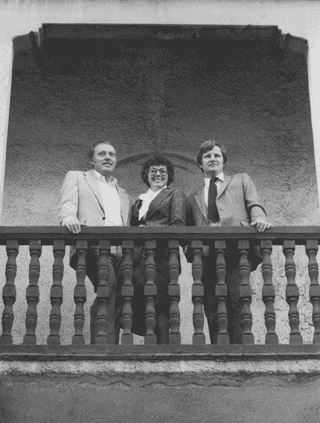
VaLoy, Ellie, and Vern
at the Springville Museum of Art, 1982
|
|